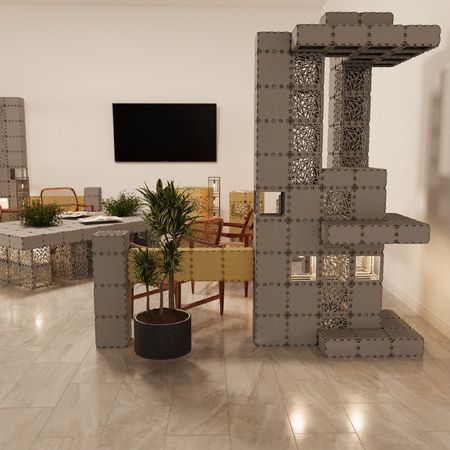
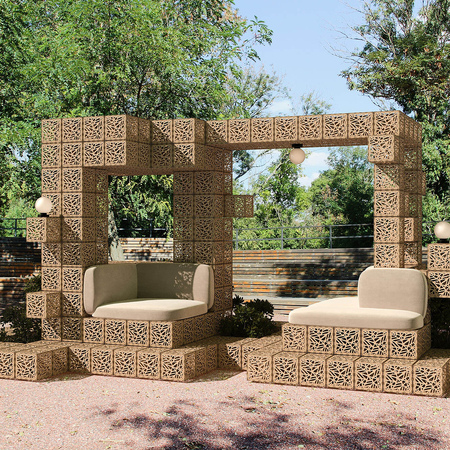
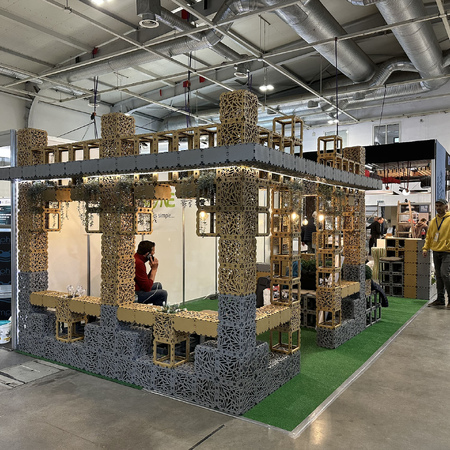
Most conversations about modular architecture focus on speed: fast builds, fast changes, fast setups. But speed is only the surface. The deeper value of modular systems lies in geometry - the shapes, heights, rhythms, and boundaries that quietly direct how people behave inside a space. A well-designed module does more than fill an area; it frames attention, guides movement, softens sound, and defines where people feel invited or protected.
Traditional architecture fixes these decisions in place. Once a wall is built, the flow is locked. Once a meeting room is placed, the team must orbit around it, even if their work changes. Modular geometry works differently. With reconfigurable structures, every spatial choice becomes adjustable: openings can shift, heights can rise or lower, boundaries can tighten or open. And when geometry can change, behavior can change with it.
Across offices, event halls, retail floors, and public spaces, small geometric shifts - a rotated panel, a softened corner, a narrower gap, a raised header - often matter more than furniture or décor. They influence whether people pause or pass, collaborate or retreat, focus or drift. In this sense, modularity is not just practical; it is behavioral design.
This article explores how reconfigurable structures shape human experience, and why the underlying geometry of systems like Cubik.one offers a level of control that fixed architecture cannot match.

Geometry as a Quiet Language: How Space Directs Behavior
Before people read signs, schedules, or instructions, they read geometry. The shape of a boundary, the angle of an opening, the height of a divider, or the alignment of two panels silently communicates how a space should be used. This is not intuition - it is pattern recognition shaped by years of navigating rooms, streets, queues, hallways, plazas, and workplaces. When geometry is fixed, behavior becomes predictable but rigid. When geometry can change, the space becomes a tool for shaping new patterns.
In open offices and event halls, for example, most “problems” (noise, distraction, wandering flow, overcrowding, underused corners) are geometric before they are behavioral. Too much depth invites gatherings where you don’t want them. Straight pathways accelerate movement and noise. Sharp angles create echo points. Full-height enclosures isolate too strongly, while half-height boundaries invite interruptions. Each geometric decision nudges people toward or away from focus, collaboration, rest, or circulation.
Modular systems introduce a different paradigm: instead of working around the limitations of the building, you can create a secondary “layer” of geometry that actually does the behavioral work. A slight rotation of a frame can slow foot traffic enough to create a breakout pocket. A lowered header can psychologically “quiet” a focus area without sealing it. A staggered set of panels can soften echo in a way no fixed drywall ever tried to address. Because the modules are reconfigurable, the space becomes a living diagram - something you can tune, test, and adjust as teams, seasons, or events evolve.
Subtle interventions that strongly affect behavior:
- Offset openings → redirect sightlines and reduce interruptions.
- Staggered panels → create privacy pockets without closing space.
- Lowered headers → signal a quieter zone and slow the pace of movement.
- Angled frames → guide natural flow and prevent congestion.
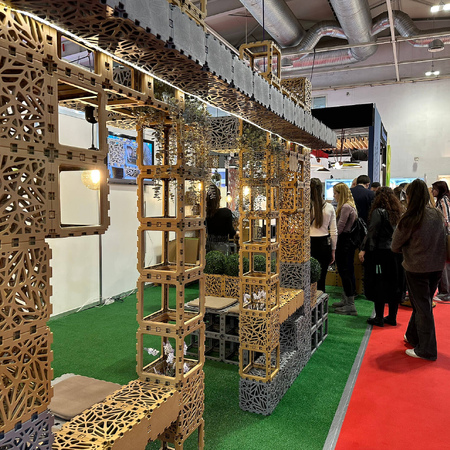
- Perforated elements → soften acoustics while preserving openness.
Design insight: People respond to boundaries even when they are only implied. A simple geometric cue - a corner, a break in height, a repeated vertical rhythm - is often enough to shift behavior without building a wall.
Adaptive Geometry: Why Reconfigurable Structures Outperform Fixed Architecture

Fixed architecture is efficient only when behavior is stable. But in most real environments - offices, exhibitions, retail, cultural spaces - behavior shifts constantly. People gather unexpectedly, teams re-form weekly, product displays rotate monthly, and foot traffic changes by hour. Fixed walls cannot respond to these rhythms. Modular geometry can.
Reconfigurable structures let you adjust the three elements that most strongly influence human behavior: orientation, openness, and thresholds. Each of these acts like a lever. A small shift in orientation changes where people look and how they move. A change in openness transforms whether a space feels collaborative or private. A well-designed threshold decides whether someone enters, pauses, or simply glances and walks on. When these elements can be manipulated freely, the designer gains a level of control that is impossible with permanent walls.
Modular systems such as Cubik.one turn these levers into an everyday toolkit. Panels can open a zone in the morning for group flow and shelter it in the afternoon for focus. A retail kiosk can widen its frontage during peak hours and reconfigure into a more directive, guided layout for slower traffic. Event spaces can create micro-rooms, launch areas, photo spots, or queue lines simply by shifting angles and adding or removing verticals. Teams don’t need construction - they use geometry as strategy.
Three behavioral levers unlocked by modular geometry:
- Orientation: Rotate a panel 10-15 degrees and you redirect circulation, creating smoother flow or intentional pauses.
- Openness: Adjust height or transparency to shift from “approachable” to “protective” without closing a space entirely.
- Thresholds: Shape how people enter by framing an arch, narrowing a gap, or adding a partial return panel - each option subtly changes participation.
Design insight: People tend to follow the path of least resistance, but “least resistance” is created by geometry. When you can change the geometry, you can change the path - and the entire experience.
Real-World Scenarios: How Modular Geometry Shapes Use, Comfort, and Experience

Geometry becomes truly powerful when it is applied to real situations - the noisy office corner, the overstimulating exhibition hall, the retail zone with unpredictable traffic, or the public space that must serve multiple groups in one day. In each case, the challenge is never just “furniture” or “walls.” The challenge is how people behave, and behavior is shaped by geometry long before a space is furnished.
Reconfigurable systems allow designers, teams, and event managers to tune these behaviors by adjusting heights, angles, apertures, and rhythms. Instead of forcing a single layout to solve every need, modular geometry makes it possible to create micro-environments that shift purpose throughout the day or season. The same frames can support focus work in the morning, collaboration by midday, and a social lounge in the evening - simply by changing boundaries and orientations. This fluidity is where modularity outperforms traditional architecture.
Below are real scenarios where geometric decisions drive clear behavioral outcomes.
Scenario 1: Quiet Work in an Open Office
A team struggles with noise and visual interruptions. Instead of building enclosed booths, they use staggered modular panels, a lowered header, and an offset entrance.
This simple geometry:
- reduces cross-sightlines,
- softens sound reflections,
- slows foot traffic near the area.
The result: a quiet zone without isolation or construction.
Scenario 2: Collaboration Near a High-Traffic Path
An open collaboration area sits too close to a corridor. People walking by create noise and visual distraction. By rotating the backdrop panel and adding a shallow return, flow diverts naturally around the space rather than through it.
Small geometric tweaks lead to:
- fewer interruptions,
- more focused teamwork,
- a clearer sense of “inside” vs. “outside.”
Scenario 3: Retail Pop-Up That Must Adapt Hour by Hour
Foot traffic peaks at lunchtime and thins in the afternoon. With fixed architecture, the kiosk remains static; with modular geometry, it changes posture throughout the day.
- Morning: wide-open frontage invites browsing.
- Peak hours: angled panels guide movement to reduce congestion.
- Afternoon: narrowed entry creates a more curated, intentional experience.
The structure adapts to behavior instead of hoping behavior adapts to structure.
Scenario 4: Public Space Serving Multiple User Groups
A civic plaza hosts families in the morning, co-working in the afternoon, and an event in the evening. Fixed infrastructure cannot serve all three. Modular frames, however, can form:
- low boundaries for child-friendly play zones,
- semi-private work pods using perforated panels,
- an evening pavilion with defined entrances and sightlines.
Geometry becomes a universal tool: inclusive, responsive, and reusable.
Design insight: when you understand how people react to height, angle, openness, and thresholds, you gain the ability to design not just spaces - but experiences. Modular systems amplify this ability by letting you test, refine, and evolve geometry over time.
System Thinking: How a Modular Toolkit Controls Geometry, Flow, and Experience

A modular system becomes truly powerful when it stops acting like a set of parts and starts acting like a language - a consistent way to define boundaries, rhythms, hierarchies, and interactions. Cubik.one works precisely this way: not as furniture, not as temporary construction, but as a geometric framework that can be rewritten as often as needed. When the components are coherent, versatile, and repeatable, the designer gains control over patterns of use that traditional architecture can’t easily influence.
At the core of this system thinking is the idea that simple geometric units, repeated and reconfigured, create predictable behavior without rigid constraints. A single frame, depending on height, angle, or transparency, can encourage focus, direct movement, shape a queue, or create a quiet pocket. This makes modular geometry less about “building something” and more about sculpting the flow and comfort of a space in real time.
How Cubik.one frames shape space and behavior
- Consistent Dimensions → Predictable Boundaries
The regular grid of frames establishes a legible rhythm. People intuitively read where a zone begins or ends, even without doors or full-height walls. - Reconfigurable Heights → Adjustable
Privacy and Presence Lower setups invite participation; mid-height screens create gentle separation; taller assemblies introduce privacy and acoustic control without enclosure. - Angles and Offsets → Flow Control
Without Signage A slight rotation of a module redirects circulation; an offset entry guides people to pause, look, or transition more slowly. - Transparency Choice → Visual and Acoustic
Tuning Solid panels provide shielding, perforated ones soften sound while keeping openness, and open frames preserve sightlines - each shifts behavior differently.
Modular components as behavioral tools
- Panels create sightline boundaries, reduce distraction, and signal function.
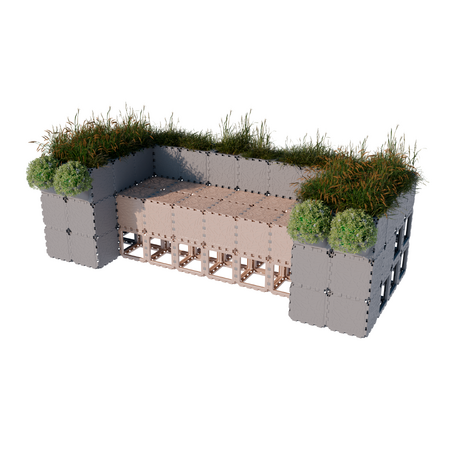
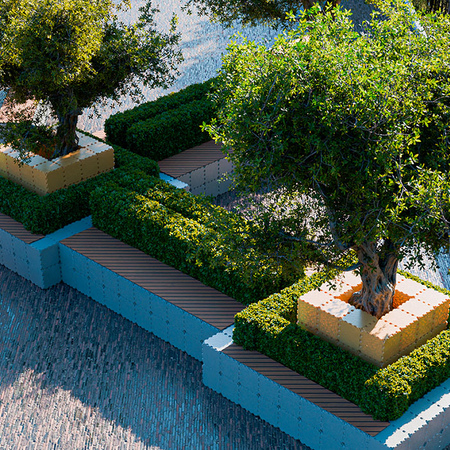
- Planters add mass and softness - a natural way to shape edges without building walls.
- Headers define psychological height and quiet a zone without closing it.
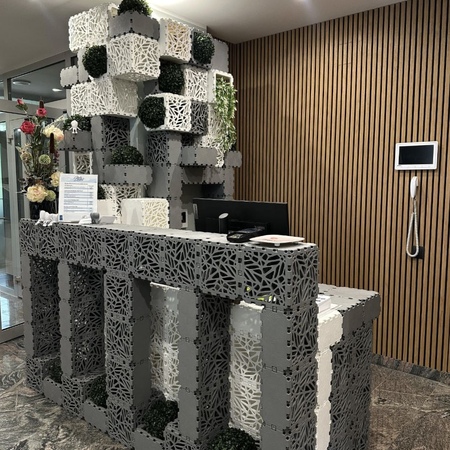
- Benches and counters anchor a purpose, whether focus, gathering, or rest.
- Returns and corners provide small pockets of protection that encourage lingering.
Each piece carries behavioral meaning far beyond its physical size.
When components share a unified logic, the same kit can become:
- a high-focus booth,
- an ideation bay,
- a guided retail path,
- a queueing zone,
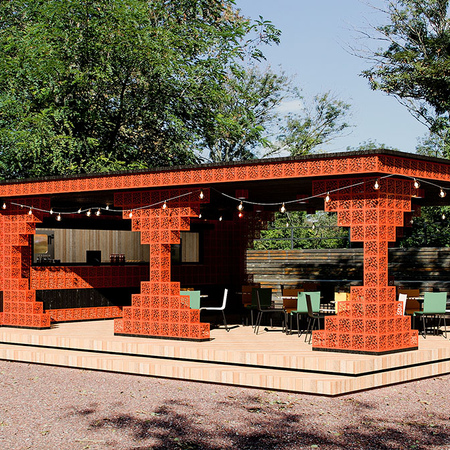
- a micro-pavilion,
- a breakout lounge,
- or a calm waiting area.
Not by replacing parts - but by rearranging geometry.
This is the strength of a modular system: the ability to prototype, test, refine, and evolve space without committing to permanent outcomes.
Design insight: The real power of modularity is not flexibility alone - it is the ability to use geometry intentionally, to craft experiences that match changing needs without rebuilding the environment each time.
Conclusion: Designing Behavior Through Reconfigurable Geometry
Spaces shape people long before people shape spaces. The angles we walk through, the openings we notice, the boundaries we sense - all of it directs our movement, focus, comfort, and interactions. Traditional architecture fixes these patterns in place. Modular geometry, by contrast, keeps them open, adjustable, and responsive.
Reconfigurable systems like Cubik.one turn spatial design into an ongoing dialogue. Instead of making one decision that must last for years, teams can tune layouts to changing needs, test how people respond, refine the geometry, and arrive at solutions that feel natural rather than enforced. A frame shifts, a panel rotates, an entry narrows, a header rises - and the behavior of the space changes with it.
In a world where workflows, events, teams, and communities evolve faster than buildings do, modular geometry offers something rare: the ability to redesign experience without restarting from zero. It gives designers not just a set of tools, but a living language - one that grows, adapts, and keeps shaping the way people meet, move, work, and gather.
_450x450_390.jpeg)